
Hamilton County Bench Warrant Basics
A bench warrant is court process connected to a case or an unfulfilled court direction. A missed setting or failure to appear can prompt a court to issue process; a docket might then show an FTA or bench-warrant action. That notation does not answer whether the warrant is still active. The issuing judge and clerk control the case record and any recall procedure.
Hamilton County’s criminal cases are divided among district, county, justice, and municipal courts. A traffic citation in Hamilton Municipal Court, for example, is not searched or paid through the district court. Do not assume that one county portal covers every court or every kind of obligation.
Hamilton County Traffic Dates and FTA Notices
For a traffic matter, first identify whether the citation names Hamilton Municipal Court or JP Precinct 1. The Hamilton city court handles city citations and accepts payments only for its own tickets; JP1 has a separate court form and payment route. A missed date or unpaid citation may have consequences ordered by that court, but the reviewed materials do not state a universal county fee, warning period, or grace interval.
Read the ticket for the exact court and cause information. If the document is missing, contact the court that issued it and ask what record details it needs to locate the matter. A countywide assumption can send a person to the wrong counter.
How Hamilton County Bench Warrants Enter a Case
The judge’s order and case docket are the controlling starting points. A case event may note a missed appearance or bench-warrant action, while a separate process record may not appear in a public online view. The county-linked case portal is a research lead only; it is not a verified live warrant search. Ask the issuing clerk what the docket event means and whether an order has since changed it.
No public Hamilton County warrant-number format or status field was found. Do not infer issuance or current validity from a case number, an old docket note, or a search result from another jurisdiction. A clerk can direct a request to the proper judicial record route.
Hamilton County Court Portals Do Different Jobs
The County Clerk links County Court criminal docket information but states that staff do not conduct public searches. The District Clerk directs judicial case-record requests to a Records Request search form. JP1 and municipal courts maintain separate lower-court records. These distinctions matter when a person has a citation, county-court cause, or district-court case but does not know which office to contact.
County Clerk information, the District Clerk request page, and Hamilton Municipal Court show the separate local routes.
Use the case name and number from the paper to identify the court, then ask whether the record shows a warrant action and what the court requires next. Neither a general portal nor a clerk’s records search should be described as a countywide open-warrant roster.
The 220th District Court page provides the court’s contact and docket route.
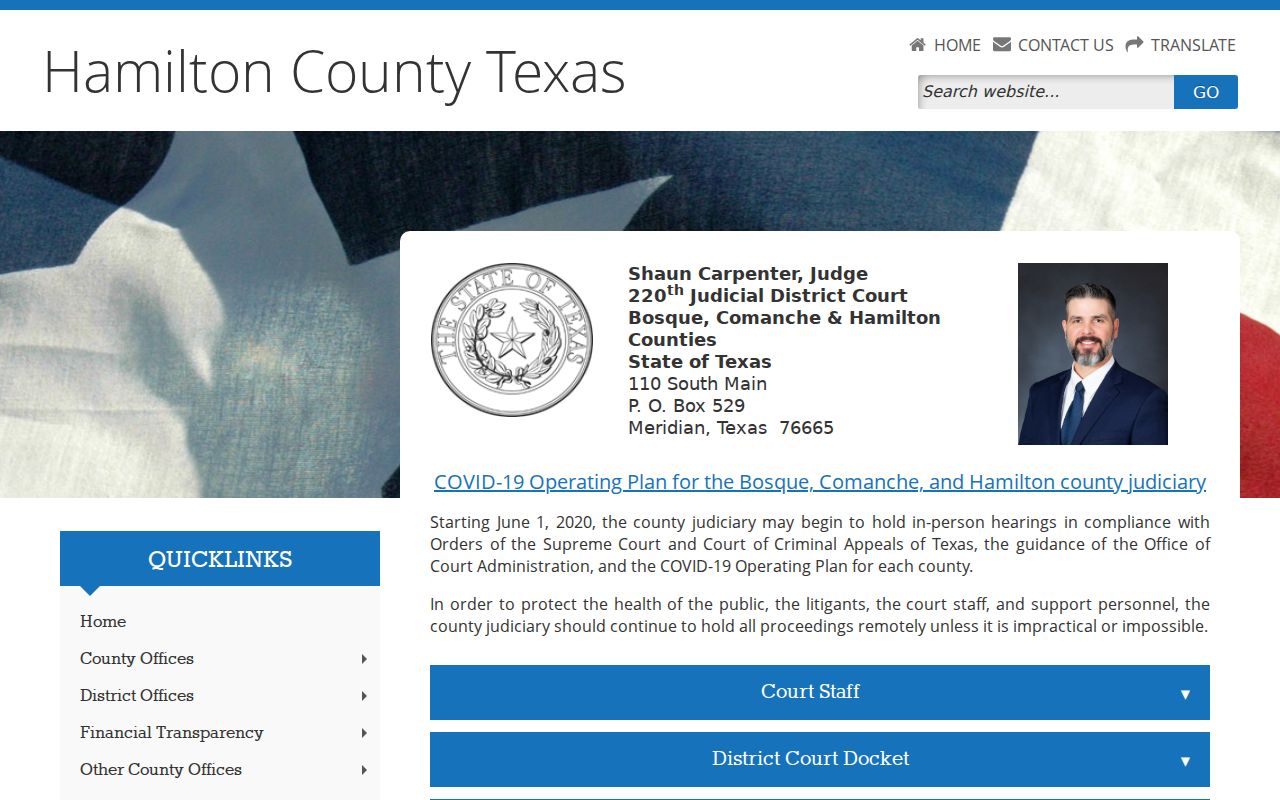
Use the court contact to route a district case; a status question still belongs with the issuing court.
Bench Warrants and Arrest Warrants in Hamilton County
A bench warrant follows a court event or obligation in an existing matter. An arrest warrant generally arises from a criminal investigation and a judicial probable-cause determination. The documents and procedures differ, even though both can authorize custody. A bench entry should be checked with its issuing court; the sheriff’s general contact page does not establish its status. See the separate Hamilton County arrest warrant process for investigation-related records.
| Feature | Bench Warrant | Arrest Warrant |
|---|---|---|
| Trigger | Missed setting or court obligation | Judicial finding of probable cause |
| Issuing authority | Court handling the underlying case | Judge or magistrate |
| Case link | Existing court matter | Investigation or criminal charge |
| Next step | Ask issuing court about appearance or recall | Confirm through counsel and court |
Hamilton County Capias Pro Fine Rules
Texas Code of Criminal Procedure Article 45A.259 addresses a capias pro fine when a person has not satisfied a fine-and-cost judgment. It requires the order to state the amount owed and describes circumstances in which the court recalls the capias after a qualifying notice and hearing or a voluntary appearance or good-faith attempt. Whether the article applies depends on the court and case; it is not a blanket explanation of every bench warrant.
Read Article 45A.259 in the official Texas code and ask the court whether it applies to the particular judgment.
The statute concerns a specific fine-and-cost process, not a general county warrant lookup.
Steps for a Hamilton County Bench Warrant
Start by identifying the court, then ask its clerk what appears on the docket and whether an order has been entered since the warrant action. A lawyer can evaluate whether to request a new setting, file a motion, arrange an appearance, or address a fine judgment. Payment alone may not resolve every warrant, and appearing without a plan can carry consequences that vary by case.
- Locate the case paper and identify the issuing court.
- Ask the clerk what status information can be confirmed.
- Consult counsel about a motion, appearance, or other response.
- Follow the court’s order and request confirmation that the record reflects it.
Caution: No countywide recall window or walk-in surrender procedure was located; do not assume a general office visit resolves a court order.
Hamilton County Has No Published Recall Window
The reviewed county and court materials do not publish a countywide bench-warrant recall calendar, amnesty event, warrant-specific bond window, or standard walk-in surrender procedure. No universal recall fee or bond schedule was located. A court may set a case-specific appearance or filing requirement, so ask the issuing clerk how to place the question before the judge.
Bring or provide identifying details from the citation, notice, or case record. Keep the request tied to the correct court and ask what proof of payment, appearance, or compliance the court needs. Do not treat a payment receipt as confirmation that a separate warrant record has been recalled.
Which Hamilton County Court Controls Recall
A bench warrant remains within the case handled by the court that issued it. The sheriff may execute process, but does not decide whether a judge recalls it. Hamilton County’s 220th District Court handles district matters; the County Clerk is the criminal-record route for county-court cases; JP1 handles justice-court matters; and city courts handle their own citations.
Check the heading on the case paper before contacting an office. If the paperwork is unavailable, the County Clerk says its staff do not conduct public searches, while the District Clerk’s judicial-record request form is the route for district case records. The countywide warrant check overview explains those record boundaries.
Confirm the Hamilton County Docket After Court
After a hearing, payment, or other court-directed step, ask how the order will be entered and when the clerk can confirm the docket reflects it. A case event may be updated separately from law-enforcement records, and no local public warrant feed was found. Keep copies of filed motions, receipts, and signed orders so the issuing court can locate the relevant action.
If a separate license-reporting issue arose from a citation, ask the reporting court whether it sent a clearance. DPS’s FTA/FTP process is distinct from confirming a bench warrant and should not be used as a substitute for the court’s answer.